
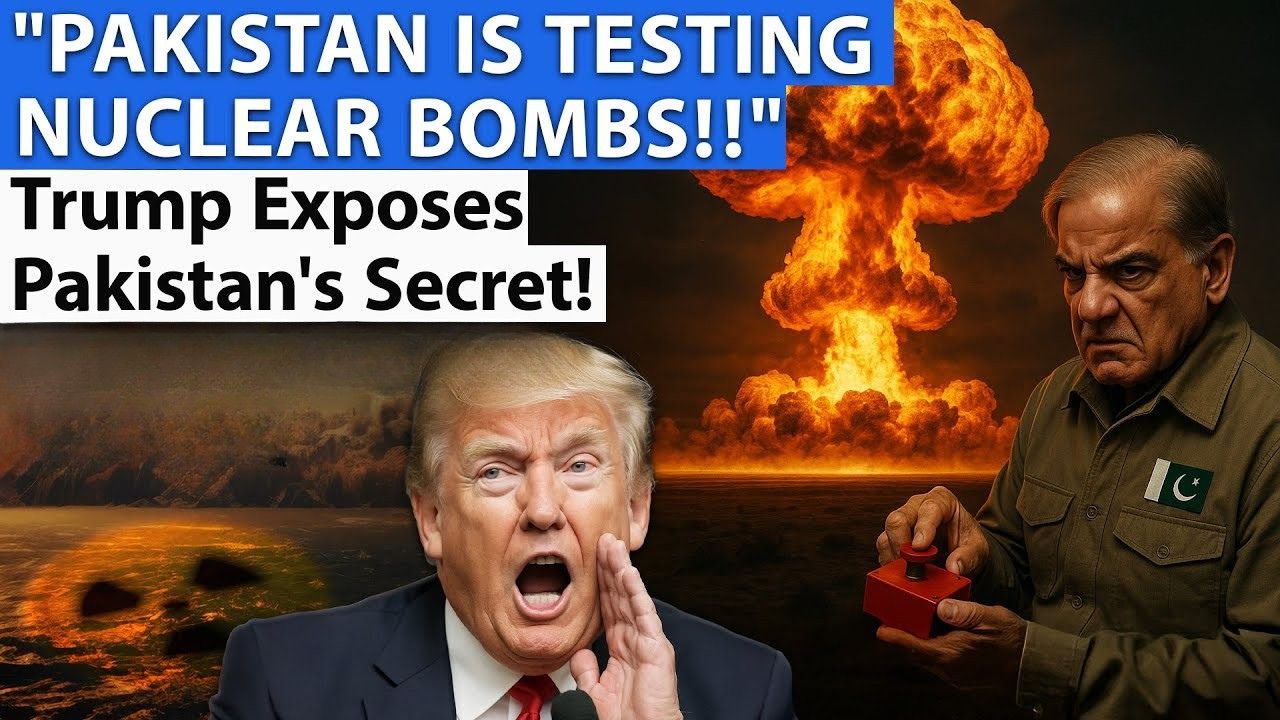

Donald Trump Nuclear Testing: Explosive Remarks That Shocked Global Security Experts
Donald Trump Nuclear Testing: Explosive Remarks That Shocked Global Security Experts
Introduction: Donald Trump’s Bold Take on Nuclear Testing
The Donald Trump Nuclear Testing controversy has once again ignited global concerns about nuclear deterrence and international security. In a bold statement, Trump claimed that Pakistan continues to test nuclear weapons, while nations like North Korea, China, and Russia conduct secret nuclear tests under strict government control.
He further suggested that the United States should resume its own nuclear tests to maintain global dominance. This declaration has triggered widespread discussions about power politics, strategic balance, and transparency.
1. Trump’s View on Media Freedom and Nuclear Transparency
In his remarks, Trump emphasized that U.S. media freedom prevents secret nuclear tests, unlike in authoritarian states. He compared the openness of the American press to that of India, suggesting both countries would expose any secretive government activity.
This angle of the Donald Trump Nuclear Testing debate highlights how democracy and transparency can influence global security narratives.
2. India–Pakistan Tensions and Strategic Imbalance
Trump noted that Pakistan continues its nuclear development, while India has not tested since 1998. This creates what he called a strategic gap that could disadvantage India.
Experts believe that Donald Trump Nuclear Testing comments may push India to reconsider its nuclear strategy, while placing diplomatic pressure on Pakistan. The remarks could also renew international scrutiny on South Asia’s nuclear capabilities.
3. Global Fallout of Donald Trump Nuclear Testing Remarks
As a former U.S. President, Trump’s words carry weight. His Donald Trump Nuclear Testing statements have the potential to reshape global arms control policies and fuel a modern-day nuclear race.
Strategic testing is often used as a symbol of deterrence, but analysts warn that such rhetoric could destabilize decades of peacekeeping and non-proliferation efforts.
4. Nuclear Testing and Global Security Challenges
Trump’s comments underline the fact that modern nuclear weapons could destroy entire nations. He argued that periodic testing ensures reliability, though critics warn this undermines disarmament.
According to the Comprehensive Nuclear-Test-Ban Treaty Organization (CTBTO), over 2,000 tests have been conducted since 1945. The Arms Control Association cautions that renewed U.S. tests could reverse global progress.
If Donald Trump Nuclear Testing ideas inspire countries like China, Russia, and India, the world could see an unprecedented escalation in nuclear rivalry.
5. Strengthening South Asia’s Nuclear Resilience
The Donald Trump Nuclear Testing controversy also spotlights South Asia’s need for cooperation. India and Pakistan must strengthen nuclear confidence-building measures, engage in transparent dialogue, and reinforce non-proliferation frameworks.
Economic partnerships and people-to-people engagement can serve as stabilizing forces to prevent nuclear escalation and sustain peace in the region.
Conclusion: The Future of Donald Trump Nuclear Testing Debate
Ultimately, the Donald Trump Nuclear Testing discussion reminds the world how a single leader’s statement can reshape international security policies. Trump’s words challenge long-standing nuclear norms and push global powers to re-evaluate their deterrence strategies.
To prevent escalation, world leaders must uphold non-proliferation treaties, strengthen transparency, and commit to peaceful diplomacy. Whether the next decade witnesses renewed testing or restraint depends on how seriously nations take this wake-up call.
Beyond the immediate political reactions, the Donald Trump Nuclear Testing discussion also underscores the importance of international cooperation in science and defense ethics. Many experts argue that rather than reigniting a nuclear race, world powers should invest in nuclear safety, disaster preparedness, and clean energy alternatives. Strengthening international treaties and ensuring transparency between major powers could help prevent misinterpretation of defense actions. As nations move toward technological advancement, ethical responsibility must guide how nuclear knowledge is used.

 By
By









Who knew one mans tweets could rattle the global nuclear cage so hard? Trumps musings on testing are like someone randomly flipping a light switch in a bomb factory – unpredictable and potentially disastrous. While experts fret about strategic gaps and renewed races, its all quite amusingly chaotic. The article sounds like a serious lecture, but honestly, imagining China, Russia, and India potentially taking up the testing baton is almost cartoonish. Lets hope the worlds leaders remember their non-proliferation promises before we end up needing actual nuclear preparedness plans for real disasters, not hypothetical ones sparked by social media rants. Phew! Glad we have treaties and dialogue to sort this out… eventually.
Who knew one mans tweets could rattle the global nuclear cage so hard? Trumps musings on testing are like someone randomly flipping a light switch in a bomb factory – unpredictable and potentially disastrous. While experts fret about strategic gaps and renewed races, its all quite amusingly chaotic. The article sounds like a serious lecture, but honestly, imagining China, Russia, and India potentially taking up the mantle is a sight to behold. Perhaps we should all take a deep breath, uphold those non-proliferation treaties, and maybe invest in some clean energy instead of restarting the nuclear bandwagon. After all, ethical responsibility must guide how nuclear knowledge is used, and right now, that doesnt look like its happening!